
As I organized the questionnaire responses, I became increasingly aware of something remarkable: industry designers’ understanding of “No-Anxiety Design Thinking” was far more nuanced than I had imagined. At first, I worried that the concept might be too abstract, or too dependent on my own interpretation of Chengdu’s culture. But as I read through their answers, those doubts quickly dissolved.
Many designers described their intuitive feelings about “no anxiety” in the first section of the survey, and almost all of these reflections stemmed from bodily experience and emotional states. One described it as “a design approach that allows both body and mind to relax,” another saw it as “a rhythm of breathing perceptible to the wearer,” while others viewed it as “a pathway from lifestyle to design philosophy.” Reading these words, I was overwhelmed by a sense of being understood. They seemed to articulate, in more concrete language than I ever had, the very ideas I had been striving to express.

translation:
“No-Anxiety Design Thinking” is a user-centered design philosophy that focuses on the psychological experience of users. It emphasizes that throughout the entire design process—from research and ideation to implementation—designers should consider how to eliminate potential sources of anxiety that users might experience when interacting with a product or service. This could mean making operations more intuitive, information more transparent, and experiences more comfortable, ultimately creating designs that feel safe, reassuring, and stress-free.
I believe that “No-Anxiety Design Thinking” begins from the user’s psychological comfort zone. It calls for clarity, simplicity, and predictability in functions, interfaces, and interactions, so that users can quickly understand the purpose and operation of a design. In doing so, it prevents confusion or frustration caused by ambiguity or complexity, thereby enhancing users’ trust in and satisfaction with the design.
This design mindset places “keeping users away from anxiety” as one of its primary considerations. Designers must deeply explore the psychological pain points users encounter in real use scenarios—such as resistance to complex processes or worries about uncertain outcomes—and address them through clear design logic, timely feedback mechanisms, and empathetic design language. The goal is to build a system that users can navigate with ease and confidence, free from anxiety.
Centered on the idea of “eliminating user anxiety,” this design philosophy requires designers to adopt the user’s perspective, anticipate potential confusion or stress points during use, and resolve them through thoughtful design logic, considerate functionality, and a warm visual language. In doing so, it fosters a sense of psychological comfort, allowing users to interact with the design effortlessly and with peace of mind.
translation:
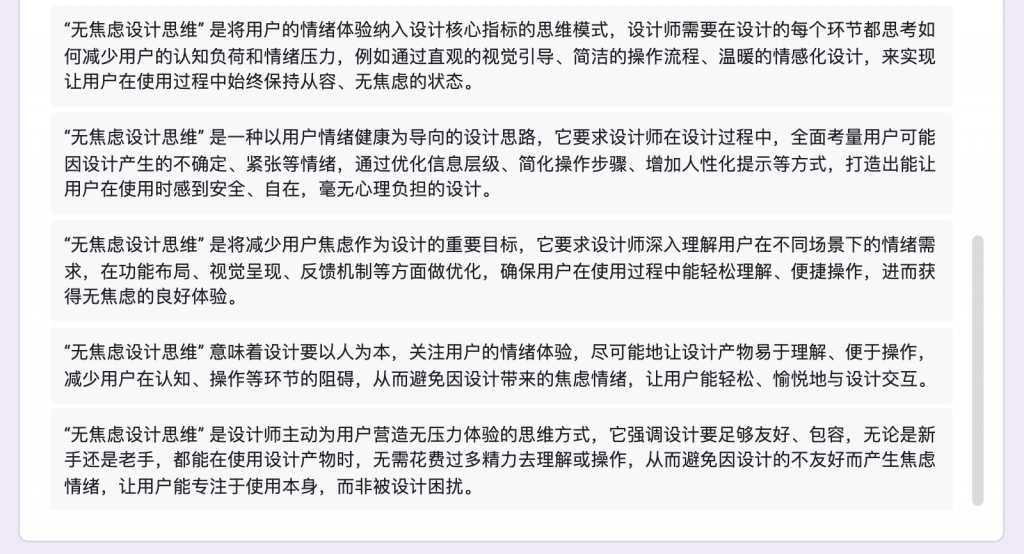
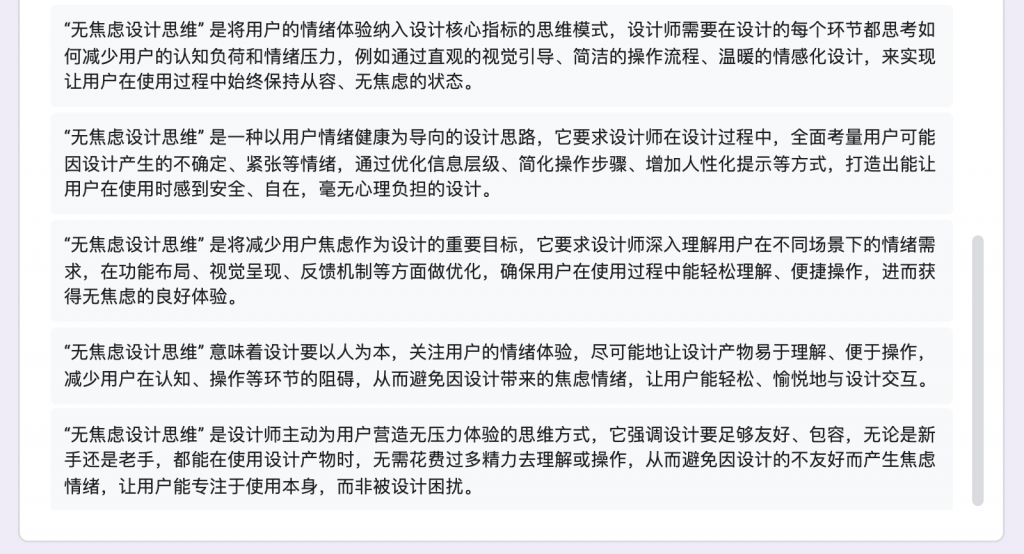
“No-Anxiety Design Thinking” is a mindset that places the user’s emotional experience at the core of design evaluation. Designers must consider, at every stage of the process, how to reduce users’ cognitive load and emotional stress—through intuitive visual guidance, simplified operation flows, and warm, emotionally engaging design—so that users can remain calm and free from anxiety throughout their interaction with the product.
“No-Anxiety Design Thinking” is a design approach guided by users’ emotional well-being. It requires designers to thoroughly consider any uncertainty, tension, or discomfort that design might cause, and to address these through clearer information hierarchy, streamlined steps, and more human-centered prompts. The goal is to create designs that make users feel safe, at ease, and psychologically unburdened during use.
“No-Anxiety Design Thinking” treats reducing user anxiety as a key design objective. It asks designers to deeply understand users’ emotional needs across different scenarios and to optimize function layout, visual presentation, and feedback mechanisms. This ensures that users can easily comprehend and operate the design, ultimately leading to a smooth, anxiety-free experience.
“No-Anxiety Design Thinking” means human-centered design that focuses on users’ emotional experiences. It strives to make design outputs easy to understand and effortless to use, minimizing cognitive or operational barriers. By doing so, it prevents anxiety induced by poor design and allows users to interact with ease and enjoyment.
“No-Anxiety Design Thinking” is a proactive mindset in which designers create stress-free experiences for users. It emphasizes friendliness and inclusivity—ensuring that both novices and experts can use the design without spending excessive effort on understanding or operating it. This prevents anxiety caused by unfriendly interfaces and allows users to focus on the experience itself rather than being frustrated by the design.
What struck me most was how they talked about Chengdu culture. Many didn’t think culture had to be represented through symbols; instead, they emphasized it as a state of being—a sense of presence, an atmosphere that allows people to feel “relaxed, unhurried, and calm.” I had assumed I would need to constantly explain the relationship between culture and design, but as I read their responses, I realized that they were already interpreting Chengdu in their own ways. Their understanding of culture was not passive reception—it was active resonance.
As I gradually organized these responses, I began to reconsider my own understanding of cultural translation. In the past, I had tried to locate meaning in explicit cultural symbols, but these designers reminded me that the true power of culture lies in experience, not in patterns. The tangible symbols—like tea bowls, pickles, or hotpot—are merely entry points. Their real value comes from the emotions and memories that people form within those scenes.
This round of questionnaires made me realize that my proposed concept of “No-Anxiety Design Thinking” is not confined to academia or text; it carries an intuitive potential for perception. And this potential is what allows it to begin transforming—from a theoretical framework into a design language.
Chinese Version
在整理问卷的过程中,我愈发意识到一件特别的事情:行业设计师对“无焦虑设计思维”的理解远比我想象的细腻。起初,我担心这个概念会不会太抽象,或者太依赖我自己对于成都文化的解读。但当我读到那些回答时,这些疑虑被迅速打消。
很多设计师在第一部分的回答里写下关于“无焦虑”的直观感受,而这些感受几乎都是从身体经验和情绪状态出发的。有人把它形容为“一种让身体和心理同时放松的设计方式”,有人认为“无焦虑”体现为一种可被穿着者感知到的呼吸节奏,也有人说这是一种从生活方式迁移到设计哲学的路径。读到这些描述时,我甚至被一种被理解的感觉包围着。他们似乎用比我更具体的语言呈现出我一直试图阐释的概念。
我印象很深的是,他们谈到“成都文化”的方式。很多人并不认为文化必须用符号呈现,反而强调文化是一种状态,一种在场感,一种能够让人感受到“松弛、不急、不慌”的氛围。原本我以为自己需要不断解释文化与设计的关系,但看到这些回答时,我突然意识到:他们已经在用自己的方式理解成都。他们对文化的感受并不是被动接收,而是主动的共鸣。
当我逐渐整理这些回应,我开始重新审视自己对文化转译的理解。过去,我总希望能从显性的文化符号里找到答案,但行业设计师提醒我,文化真正的力量来自体验,而不是来自图案。那些关于盖碗、泡菜、火锅的具体符号,只是文化的一个入口,它们真正的价值来自人们在这些场景里所形成的情绪与记忆。
这一轮问卷让我意识到,我提出的“无焦虑设计思维”并不是一个只能存在于学术中或文本里的概念,它具有一种被直觉感知的可能性。而这种可能性,让它开始成为一种设计语言,而不是一个理论框架。
Leave a Reply