English Version:
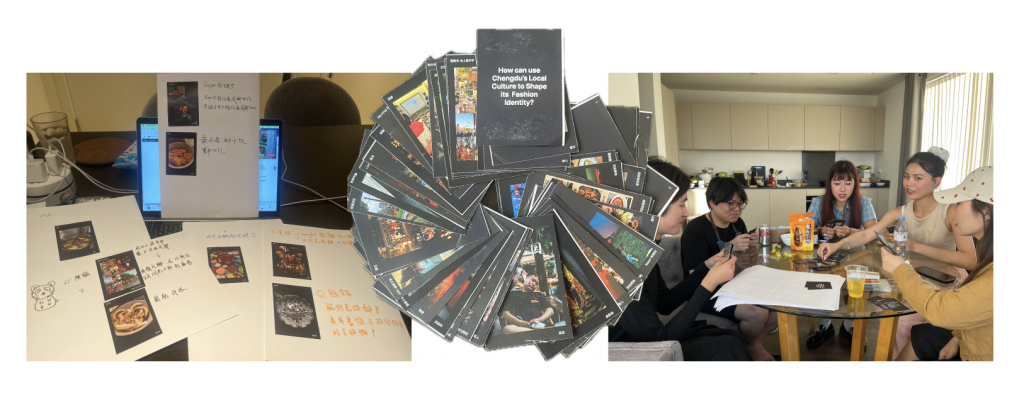
For Intervention 1, I formed two separate participant groups to explore the social and cultural dimensions of urban perception, identity, and local belonging in Chengdu. The first group, the Mixed Group, all of 6 people, consisted of two Chengdu natives and four individuals who previously visited Chengdu as tourists or have lived in multiple cities across China. The second group, the Local Group, was composed exclusively of three Chengdu-born participants who continue to live in the city. The intention behind this sampling strategy was to capture a broader spectrum of cultural interpretations and memories associated with Chengdu, and to identify how geographical identity shapes the experience of urban spaces.
The Mixed Group consists of individuals with diverse educational and cultural backgrounds. Li (29), a native of Chengdu, is currently pursuing a PhD in Human-Computer Interaction in the UK. Growing up in Chengdu has given him a deep cultural attachment to the city, while his academic background allows him to reflect on urban environments from a technological and design-driven perspective. The second Chengdu native is myself, Paris, also raised in Chengdu, with strong curiosity and interest in exploring new forms of cultural expression and media.
The remaining members of the Mixed Group bring different viewpoints as non-local participants. Miumiu (27) is from Zhejiang and is currently studying MA Interaction Arts at Goldsmiths, University of London. Her perspective is shaped by the contrast between eastern coastal cities and Chengdu’s lifestyle and cultural rhythm. Chloe (28), originally from Taiwan and studying MBA Fashion at LCF, brings a strong interest in food culture, which is one of the defining cultural markers of Chengdu. Shuang (25), from Gansu and studying MA Interaction Design at Goldsmiths, has lived in multiple cities across China. Her perception of Chengdu is deeply influenced by her ability to compare urban characteristics and evaluate cultural differences.
The rationale behind selecting these participants lies in the methodological needs of qualitative research. This study requires participants who can articulate their experiences effectively and provide insights grounded in personal narratives. The Mixed Group was particularly important because it incorporates individuals who have experienced Chengdu from both insider and outsider perspectives. Such contrast allows for a more layered understanding of urban identity and the emotional and sensory dimensions of the city. The inclusion of people with different geographical backgrounds and academic disciplines also increases the heterogeneity and richness of the data, which aligns with the principle of information-driven sampling commonly employed in qualitative research.
Chinese Version:
在本次 Intervention 1 的研究中,我形成了两个参与组,以从社会与文化维度探索城市认同、地方感与城市空间体验。第一组为 Mixed Group,一共6个人,包括两名成都本地成长者与四名曾经以游客或外来居住者身份体验成都的参与者。第二组为 Local Group,由三名成都本地出生并长期居住在成都的参与者组成。这一分组策略的目的是呈现城市印象和城市认同的多样性,并更好地比较本地人和外来者对于成都文化与生活方式的不同理解。
Mixed Group 的参与者来自不同的教育背景与文化语境。Li,29岁,出生在成都,目前在英国攻读人机交互方向的博士研究。他从小在成都成长,对城市文化具有深厚的情感记忆,同时也能够从技术与设计维度反思城市空间与体验。第二位成都本地人是我本人 Paris,同样在成都成长,对城市文化、体验方式与新兴媒介具有极强的好奇心与探索欲。
其余参与者则为非成都本地人,他们的视角为研究提供了外来者与比较性的文化视角。Miumiu,27岁,浙江人,目前在金匠学院攻读交互艺术硕士。她的视角受到沿海城市文化与成都慢生活氛围之间差异的影响。Chloe,28岁,来自台湾,在 LCF 学习 MBA Fashion,对成都美食文化尤其敏感。Shuang,25岁,甘肃人,就读金匠学院交互设计硕士,长期在多个中国城市生活,她以跨城市经验为基础,对成都的城市节奏与本地文化风格形成独特认知。
选择这些参与者基于定性研究中的样本需求:他们能够表达自身体验,并以个人叙事提供有意义的信息。Mixed Group 尤为重要,因为它包含了对成都拥有不同文化距离感的人,既有深度熟悉城市环境的本地参与者,也有从外部观察城市文化的外来者。这样的组合能够更全面呈现城市身份认同的复杂性、多层次性与多元视角。同时,这种异质化的样本构成也提升了研究资料的丰富性与有效性,符合定性研究中“信息驱动取样”的原则,为后续分析奠定基础。
Leave a Reply